Do dogs feel jealousy? They show jealousy-like behaviour in experiments
When owners pet what looks like another dog, pet dogs often push in, try to get between them, and sometimes snap more than when the owner pets a nonsocial object or reads a book. That pattern matches a simple form of jealousy seen in human infants: protect a valued bond from an interloper. Follow-up work with real dogs as rivals found the same kind of owner-oriented interrupting. Scientists still debate whether dogs have a conscious jealous feeling the way people do, and some studies with fake rivals found weaker or unclear results.
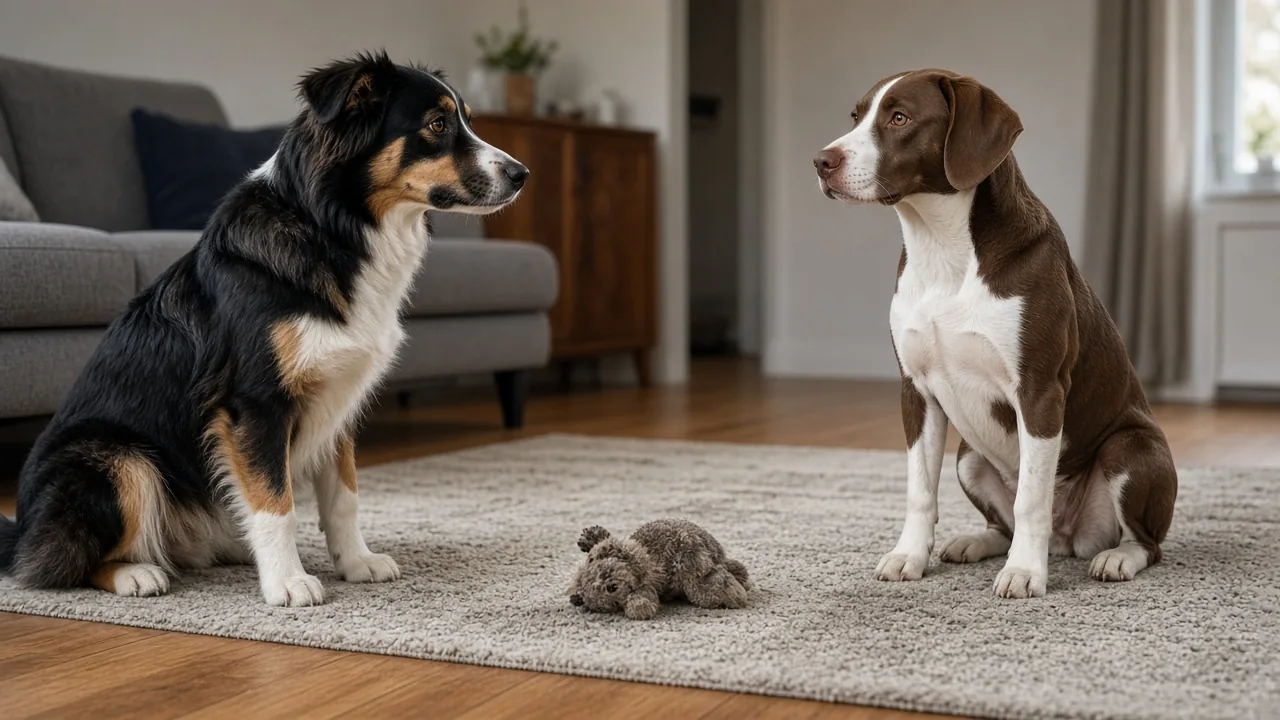
The first lab-style test of dog jealousy
In 2014, Christine Harris and Caroline Prouvost at UC San Diego adapted a method used with six-month-old human babies. They tested 36 small pet dogs at home. Owners ignored their own dog while they affectionately petted and talked to one of three things, in counterbalanced order:
- A stuffed dog that could bark, whine and wag its tail for a few seconds when a button was pressed (the jealousy condition).
- A novel jack-o-lantern pail treated the same way (affection to a nonsocial object).
- A children's pop-up book read aloud (loss of attention without an interloper).
Coders scored behaviours that owners and infant studies link to jealousy: pushing or touching the owner or object, getting between them, attention toward the owner, and aggression such as snapping.
Dogs showed significantly more of those behaviours toward the stuffed dog than toward the jack-o-lantern or the book. About one quarter snapped at the stuffed dog during the interaction, versus only one dog in each of the other conditions. After the owner set the object down, 36% snapped at the stuffed dog. Dogs also pushed or touched the owner and the object more in the stuffed-dog condition, and tried to get between owner and object more often. Whining was higher than in the book condition. Barking did not differ clearly across conditions.
Attention rose when the owner showed affection: dogs looked more at the owner and at the object in the affection conditions than while the owner read. They looked even more at the stuffed dog than at the jack-o-lantern. Most dogs treated the toy as dog-like: 86% sniffed its anal region during or after the trial, the same kind of social investigation dogs use with other dogs.
What about a real dog rival?
Critics argued a stuffed dog that barks and wags on cue might startle dogs or invite territorial reactions at home, rather than jealousy. In 2018, Judit Abdai and colleagues at Eotvos Lorand University tested dogs from multi-dog households with real partners: a familiar housemate dog and an unfamiliar dog as social rivals, plus familiar and unfamiliar nonsocial objects. Owners focused attention on each partner in turn.
Dogs showed more owner-oriented behaviour and more attempts to interrupt the owner-partner interaction when the partner was another dog than when it was an object. Interrupt attempts differed across conditions (Friedman test on 22 dogs, p < 0.001), with more interruptions for social than nonsocial partners. The authors conclude the pattern fits a functional description of jealous behaviour: it appears when a valued relationship is threatened by a social third party, not merely when attention is lost.
Why some studies still urge caution
Also in 2018, Emanuela Prato-Previde and colleagues ran two studies (36 dogs each) with a book, a puppet and a fake dog (furry in Study 1, plastic in Study 2), handled by the owner or a stranger. Dogs often sniffed the fake dog's ano-genital area, but aggressive biting never occurred, and many classic jealousy markers were absent or rare. Differences between the fake dog and the puppet were clearer only in Study 2. Dogs paid similar attention when a stranger handled the fake dog as when the owner did, which is not the pattern expected if jealousy is only about protecting the bond with the owner.
Their conclusion is careful: they do not rule out a rudimentary form of jealousy, but they argue fake rivals are a weak test and that future work should use real social interlopers and more naturalistic setups. That is why Abdai's real-dog design matters, and why the honest answer for owners is "jealousy-like behaviour, yes; full human-style jealousy, not proven."
What this means for owners
- Expect pushiness when you pet another dog. Getting between you and a guest dog is common in these studies. Manage with a lead, distance or a short "go to mat" cue rather than scolding (see reward based training).
- Rule out fear and pain first. Sudden snapping when you touch another animal can also be fear or redirected aggression. Check for stress signals such as lip licking, a tucked tail or a stiff body (reading stress), and see a vet if behaviour changes suddenly.
- Do not use dominance labels. Jealousy-like interrupting is about protecting access to you, not becoming "alpha". AVSAB advises against alpha rolls and dominance explanations (the alpha dog myth).
- Train calm sharing. Reward your dog for staying on a mat while you greet another dog or person, then release them for a turn. Short, successful rehearsals beat forcing them to "get over it".
Frequently asked questions
Do dogs feel jealousy like people do?
Dogs show jealousy-like behaviour: more pushing, getting between and sometimes snapping when owners affectionately attend to a rival dog or stuffed dog than to a nonsocial object or a book. Whether they have a conscious jealous feeling like adults do is still debated.
What did the first jealousy experiment find?
Harris and Prouvost (2014) tested 36 small dogs at home. Dogs snapped, pushed and tried to get between more when owners petted a stuffed dog than a jack-o-lantern or while reading a book. About 86% sniffed the stuffed dog's rear, suggesting they treated it as dog-like.
Does a real dog rival change the result?
Yes. Abdai and colleagues (2018) used familiar and unfamiliar real dogs plus objects. Dogs interrupted and oriented to the owner more for dog partners than for objects, which fits jealousy as protecting a social bond.
Why do some scientists still doubt it?
Prato-Previde and colleagues (2018) found that fake dogs often failed to trigger clear jealousy markers, and dogs reacted similarly when a stranger handled the fake dog. They urge using real social interlopers before claiming human-like jealousy.
How should I handle a jealous dog?
Manage space, reward calm alternatives such as going to a mat, and avoid dominance punishments. If snapping or fear is escalating, contact your vet or a certified behaviour professional (see when to get help).
Sources
- Harris CR, Prouvost C (2014). Jealousy in Dogs. PLoS ONE 9(7): e94597. DOI 10.1371/journal.pone.0094597, PLoS ONE (open access)
- Abdai J, Baño Terencio C, Pérez Fraga P, Miklósi Á (2018). Investigating jealous behaviour in dogs. Scientific Reports 8:8911. DOI 10.1038/s41598-018-27251-1, Scientific Reports (open access)
- Prato-Previde E, Nicotra V, Pelosi A, Valsecchi P (2018). Pet dogs' behavior when the owner and an unfamiliar person attend to a faux rival. PLoS ONE 13(4): e0194577. DOI 10.1371/journal.pone.0194577, PLoS ONE (open access)
General education only, not veterinary advice. If you are worried about your dog, contact your vet; in an emergency, contact an emergency vet straight away.