Why do dogs yawn? Sometimes stress, sometimes they catch yours
Dogs yawn when they are sleepy, but yawning is also one of the stress signals vets and behaviour researchers watch for, alongside lip licking and a lowered body. Several experiments also suggest that some dogs catch human yawns: in the first study, 21 of 29 dogs yawned after watching a person yawn, and none did after a fake mouth movement. Later studies found the effect is stronger with the owner than a stranger and only shows up after about 7 months of age, though one video study found almost no contagion at all.
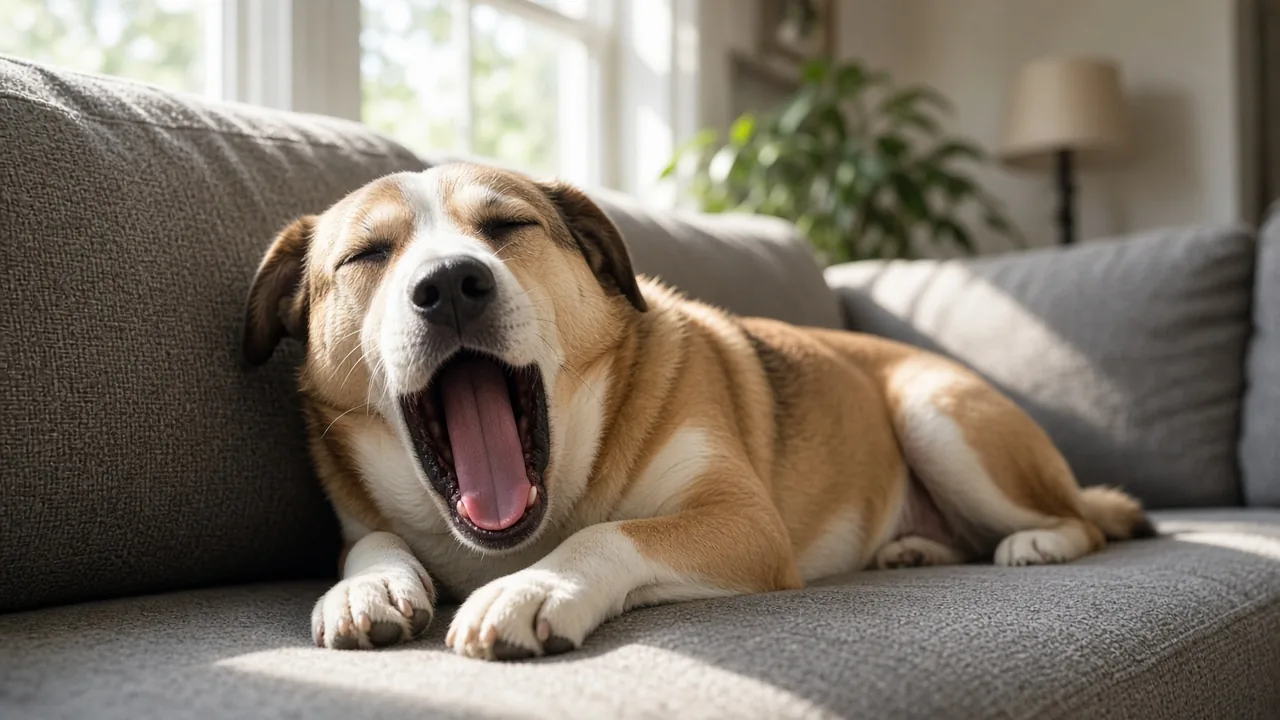
Yawning as a stress signal
A yawn on its own does not mean your dog is unhappy. Context matters. The American Veterinary Society of Animal Behavior lists yawning among the behaviours researchers recorded as stress related during training, together with lip licking, a lowered body or tail, lifting a front paw and panting (see reading stress and fear). A yawn at the vet, during a tense greeting or while being told off is more likely to be a stress yawn than one at bedtime.
Do dogs catch human yawns?
In 2008, Ramiro Joly-Mascheroni, Atsushi Senju and Alex Shepherd at Birkbeck, University of London, had a person sit in front of each of 29 dogs and either yawn or make similar mouth movements without yawning. 21 of the 29 dogs yawned after watching the yawn, and none yawned after the control mouth movements. The authors suggested this might reflect a rudimentary form of empathy, and that because yawning changes arousal, catching yawns could help dogs and people coordinate.
The result has not always repeated. In 2009, Aimee Harr and colleagues showed 15 dogs videos of humans and dogs yawning or simply opening their mouths. Only one dog yawned significantly more to the yawning videos, mostly to the human ones. Watching a screen may be a weaker test than a live person, but it is a reminder that the effect is not universal.
Owners are more contagious than strangers
In 2013, Teresa Romero, Akitsugu Konno and Toshikazu Hasegawa at the University of Tokyo tested 25 dogs with live yawns from their owner and from an unfamiliar experimenter. Dogs yawned more in the yawning condition than the control, and more when the owner yawned than the stranger. Heart rate, measured in 21 of the dogs, did not differ between conditions, which the authors read as evidence that these yawns were not a stress response.
The same year, Elainie Madsen and Tomas Persson at Lund University tested 35 puppies aged 4 to 14 months. The puppies yawned contagiously, but only dogs older than about 7 months showed it, and in their study a familiar person was not more contagious than an unfamiliar one. They link the age effect to a developmental increase in attention to others, similar to how yawn contagion rises in young children.
What this means for owners
- Read yawns in context. Sleepy yawns at night are normal. Repeated yawning with lip licking, a tucked tail or turning away in a tense moment is your cue to give space or end the session.
- Training sessions: if your dog starts yawning a lot, make the task easier and keep sessions short (see reward based training).
- Do not read too much into catching yawns. A dog that yawns back may be tuned in to you, but a dog that does not is not less attached. The studies disagree on how strong and how social the effect is.
- See your vet if yawning suddenly increases with other changes such as drooling, pawing at the mouth or lethargy, since mouth pain or illness can change behaviour.
Frequently asked questions
Why does my dog yawn so much?
Often because they are tired or settling down, but yawning is also one of the stress signals AVSAB lists alongside lip licking, a lowered body and panting. Look at the situation: repeated yawns in a tense moment usually mean your dog needs a break.
Can dogs catch yawns from people?
Some can. In a 2008 study, 21 of 29 dogs yawned after watching a person yawn and none after fake mouth movements. A 2009 video study found only 1 of 15 dogs showed clear contagion, so the effect varies.
Do dogs yawn more when their owner yawns?
In a 2013 study of 25 dogs, dogs yawned more when their owner yawned than when a stranger did, and their heart rate did not rise, suggesting the yawns were not stress. A puppy study the same year did not find an owner effect.
Do puppies catch yawns?
Madsen and Persson (2013) tested 35 dogs aged 4 to 14 months and found contagious yawning only in dogs older than about 7 months.
Is yawning a sign my dog is stressed?
It can be, especially with other signals such as lip licking, a tucked tail or lifting a paw. A single yawn at bedtime is just tiredness. See reading stress.
Sources
- Joly-Mascheroni RM, Senju A, Shepherd AJ (2008). Dogs catch human yawns. Biology Letters 4(5): 446-448. DOI 10.1098/rsbl.2008.0333, Biology Letters
- Harr AL, Gilbert VR, Phillips KA (2009). Do dogs (Canis familiaris) show contagious yawning? Animal Cognition 12(6): 833-837. DOI 10.1007/s10071-009-0233-0, Animal Cognition
- Romero T, Konno A, Hasegawa T (2013). Familiarity bias and physiological responses in contagious yawning by dogs support link to empathy. PLoS ONE 8(8): e71365. DOI 10.1371/journal.pone.0071365, PLoS ONE (open access)
- Madsen EA, Persson T (2013). Contagious yawning in domestic dog puppies (Canis lupus familiaris): the effect of ontogeny and emotional closeness on low-level imitation in dogs. Animal Cognition 16(2): 233-240. DOI 10.1007/s10071-012-0568-9, Animal Cognition
- Position Statement on Humane Dog Training (2021), American Veterinary Society of Animal Behavior
General education only, not veterinary advice. If you are worried about your dog, contact your vet; in an emergency, contact an emergency vet straight away.